Solid or hollow-core WPC decking – which option is right for your terrace?
In short:
Solid WPC decking boards have a solid profile throughout, while hollow-core WPC decking boards contain hollow chambers inside the profile. Both options are suitable for terrace construction. Which board is right for your project depends on factors such as the preferred profile, terrace construction, board weight, design and budget.
What is the difference between solid and hollow-core decking?
The main difference is the construction of the profile.
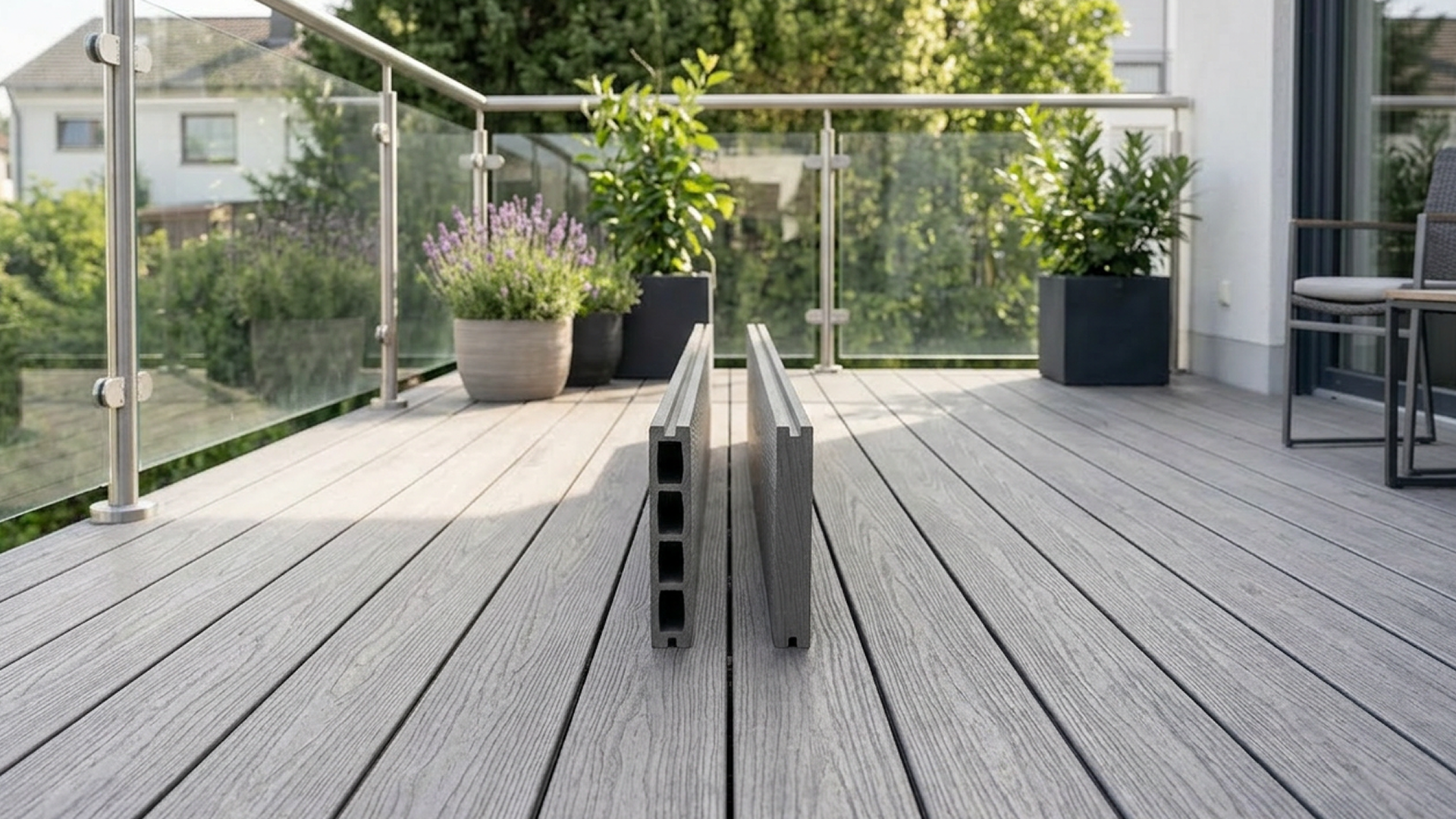
Solid WPC decking boards have a solid profile throughout and do not contain hollow chambers.
Hollow-core WPC decking boards, on the other hand, contain hollow chambers inside the profile. This reduces the amount of material used and makes the boards lighter.
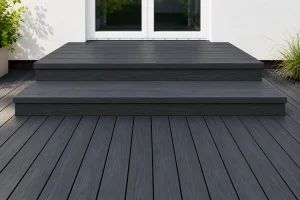
Once installed, this structural difference is usually barely visible from above. The appearance of the finished terrace is influenced primarily by the colour, surface texture and laying direction of the decking boards.
Solid WPC decking boards
A solid decking board has a solid profile throughout. This makes its internal construction fundamentally different from that of a hollow-core board.
Due to their construction, solid profiles generally have a higher weight. When planning your terrace, it is therefore worth considering not only the dimensions of the area but also transport, handling and the intended substructure.
Another difference becomes visible when a board is cut: a solid board has no open hollow chambers at the cut edge. This can be an advantage for individual cuts and certain edge solutions.
Hollow-core WPC decking boards
Hollow-core decking boards contain several hollow chambers inside the profile. As a result, they are generally lighter than comparable solid profiles.
The lower weight can make the boards easier to handle during transport and installation. The hollow-core construction also requires less material for the profile.
When boards are cut or their ends remain visible, the hollow chambers may be exposed. It is therefore useful to consider during the planning stage how visible edges and board ends will be finished.
Is solid decking always better?
No. The profile type alone does not determine which decking board is the better choice for a particular project.
Other factors also play an important role, including the dimensions of the board, material composition, intended substructure, installation conditions and the installation requirements for the individual product.
The choice between solid and hollow-core decking should therefore not be based solely on which profile contains more material.
Classic or co-extruded – another important difference
Solid or hollow-core describes the internal construction of the profile. Independently of this, WPC decking boards can also differ in their surface and material technology.
At Extrawood, you can choose between decking boards from our Classic Series and co-extruded WPC decking boards from our Premium Series.
With co-extruded decking, the WPC core is surrounded by an additional protective polymer layer. This protective layer makes the surface particularly resistant to moisture and stains and also makes it easier to maintain.
When choosing a decking board, the profile type and surface technology should therefore be considered separately.
Which option is lighter?
Because of their hollow chambers, hollow-core boards generally have a lower weight than solid boards of comparable dimensions.
This can be practical during transport, storage and installation. However, the actual weight always depends on the specific product, its dimensions and material composition.
Which option looks better?
Whether a decking board has a solid or hollow-core profile says relatively little about the appearance of its visible surface.
Depending on the collection, different colours and surface finishes are available – including finely brushed, finely grooved and more pronounced wood-grain finishes.
As colours and textures can look different on a screen than they do in real life, we recommend viewing a sample of your preferred decking board before ordering.
At Extrawood, you can order up to 5 WPC samples free of charge. Shipping of samples within Germany is also free.
What should you consider when planning?
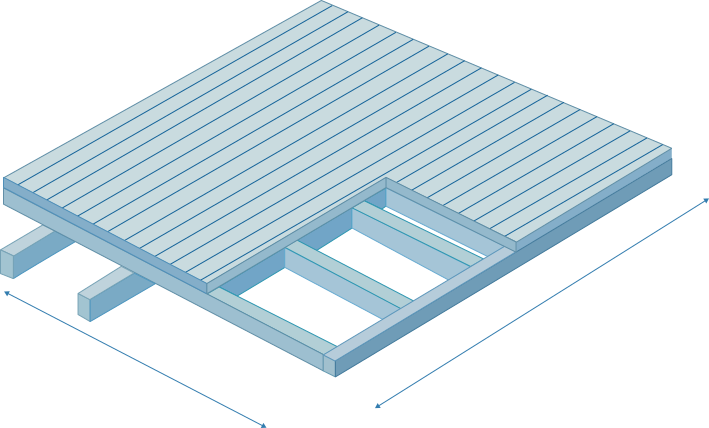
Whether you choose solid or hollow-core decking, the entire terrace construction needs to be suitable for the selected product.
Important factors include:
- the dimensions and shape of the terrace
- the laying direction of the decking boards
- a suitable substructure
- the required spacing of the substructure
- the fastening system
- edges and finishing areas
- ventilation and drainage of the construction
Always follow the installation requirements for the specific decking board.
Solid or hollow-core – how do you choose?
If a solid profile and closed cut edges are important to you, a solid decking board may be the right choice.
If you prefer a lower board weight, a hollow-core decking board may be worth considering.
Design, colour and surface finish can then be selected independently of the profile type. Depending on the specific product and planned construction, both profile types can be suitable for a WPC terrace.
Calculate the materials for your terrace
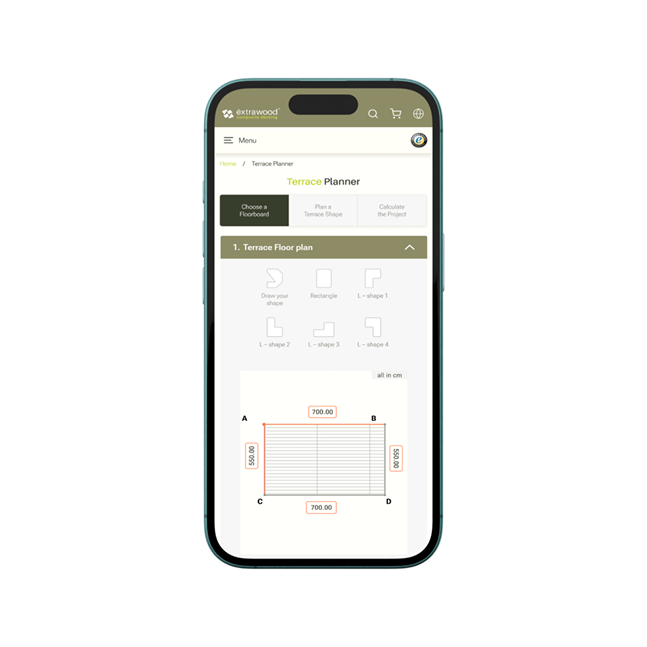
If you already know which decking board you would like to use, you can plan your terrace individually with our Terrace Planner.
First choose your preferred decking board, then select the shape of your terrace and enter its dimensions. You can then compare the different calculated layout options.