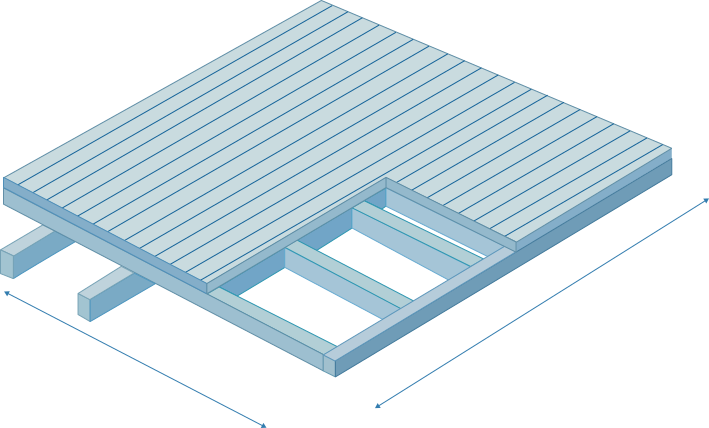
Step by step: how to plan your terrace properly
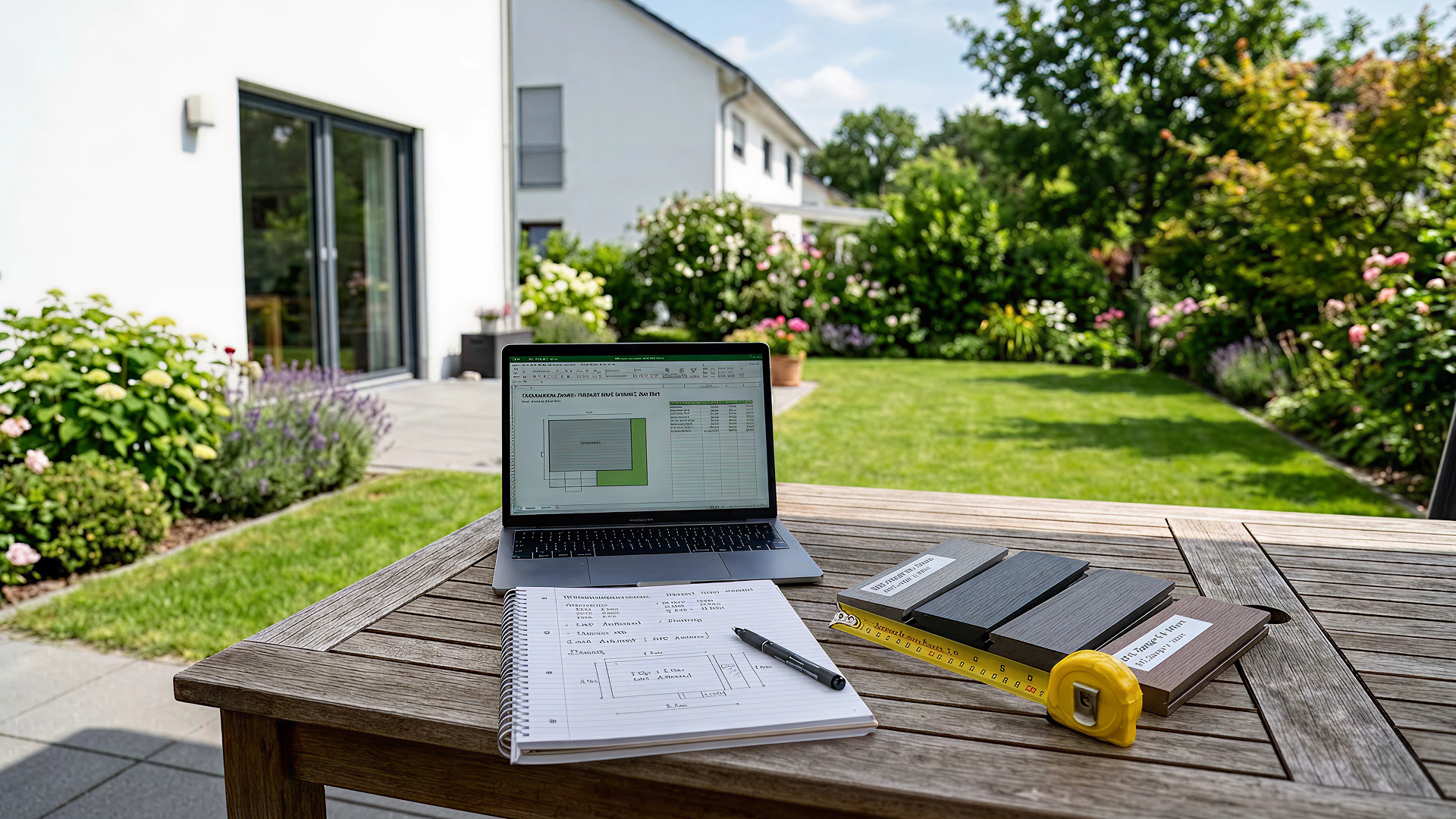
In short:
Measure the area accurately, choose the right decking board, check the existing surface and planned construction, calculate the material requirements and make sure all necessary accessories are included. Careful planning helps to avoid unnecessary offcuts, missing components and delays during installation.
Planning your terrace: Why good preparation matters
Building a terrace may seem straightforward at first. In practice, however, many problems begin during the planning stage – for example, because of inaccurate measurements, unsuitable material choices or missing components.
A clear step-by-step approach makes the entire project easier to prepare. Before ordering, you can determine which decking boards, substructure and accessories are required for your terrace.
Step 1: Measure the area accurately
Accurate measurements are the basis of every terrace project. Start by measuring the length and width of the area where the terrace will be installed.
Pay particular attention to:
- corners, recesses and unusual terrace shapes
- obstacles such as downpipes, steps or fixed elements
- areas that will not be covered with decking boards
- the planned laying direction of the decking boards
Also allow for the necessary offcuts. The amount of additional material required depends on factors such as the shape of the terrace, the laying direction and the board lengths used.
Step 2: Choose the right WPC decking board
Once you have measured the area, choose a decking board that suits your project and the appearance you want to achieve.
Extrawood offers a range of WPC decking boards, including boards from our Classic Series and co-extruded WPC decking boards from our Premium Series.
You can also choose between different profile types, colours and surface finishes, including hollow-core and solid WPC decking boards.
The most suitable option for your terrace depends on the properties you are looking for, the planned construction, the design and your budget.
Step 3: Check the existing surface and construction height
Before choosing the substructure, check the existing surface and the available construction height.
Consider the following questions:
- Is the surface level, or do differences in height need to be compensated for?
- How much construction height is available?
- Is the existing surface made of concrete, paving, gravel or another suitable load-bearing material?
- Is there sufficient slope for water drainage?
Depending on the construction, the substructure can be supported on a suitable surface or installed on height-adjustable pedestals.
Adjustable pedestals are particularly useful when differences in height need to be compensated for or a specific construction height is required. However, they are not necessary for every terrace.
Step 4: Calculate the material requirements
Once the terrace shape, dimensions, decking type and planned construction have been determined, you can calculate the required materials.
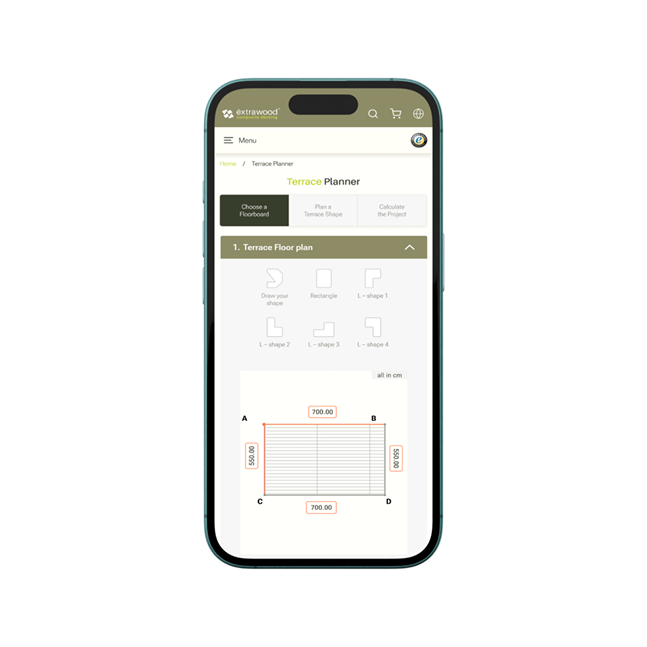
With our Terrace Planner, you can enter the shape and dimensions of your terrace and select your preferred decking board.
The Terrace Planner helps you calculate the required quantities of:
- decking boards
- substructure
- fastening materials
- height-adjustable pedestals, where applicable to the selected construction
Different board lengths can also be taken into account when planning the terrace, helping you adapt the layout more efficiently to the available dimensions.
Step 5: Include fastening materials and accessories
Decking boards are only one part of the terrace construction. The appropriate components for the substructure and fastening system also need to be included in your planning.
Depending on the selected system, these may include:
- substructure
- WPC fastening clips
- stainless steel start and end clips
- suitable screws
- height-adjustable pedestals, if required
- additional components for edges and finishing areas
You can find an overview of the available components in our WPC decking accessories section.
Alternatively, you can choose a WPC complete decking set, where the essential components are already put together according to the selected terrace size.
Step 6: Check the colour and surface with samples
Colours and surface finishes can look different on a screen than they do in real life. Lighting conditions, the surroundings and the façade of the building can also influence how a decking board looks once installed.
We therefore recommend checking your preferred colour and surface finish with a physical sample before placing your order.
At Extrawood, you can order up to 5 WPC samples free of charge. Shipping of samples within Germany is also free.
Step 7: Think through the installation before ordering
Before completing your order, it is worth going through the planned construction once more from start to finish.
In particular, check:
- the laying direction of the decking boards
- the position and layout of the substructure
- the required spacing between components
- edges and connection areas
- sufficient ventilation and drainage of the construction
Always follow the installation requirements specified for the individual product.
Common mistakes when planning a terrace
Many problems can be avoided before the materials are ordered. Some of the most common planning mistakes include:
Inaccurate measurements: Even small measuring errors can affect the material calculation.
Not allowing for offcuts: Cutting boards and adapting them to the shape of the terrace can increase the amount of material required.
Not checking the existing surface: Uneven areas and the available construction height affect the choice of substructure.
Forgetting accessories: Fastening clips, start and end clips, screws and other required components should be included from the beginning.
Choosing the colour only from a screen: A physical sample gives you a more realistic impression of the colour and surface finish.
Conclusion: Plan your WPC terrace step by step
Careful planning provides a solid basis for a well-prepared terrace project. Start with accurate measurements, then choose the right decking board and check the existing surface and available construction height.
You can then calculate the material requirements and make sure that the substructure, fastening materials and other necessary accessories are included.
For an individual material calculation, use our Terrace Planner. If your terrace size matches one of our pre-configured options, you can also choose from our WPC complete decking sets.